

Closing the AI Skills Gap Starts with Foundational Reading Skills Development
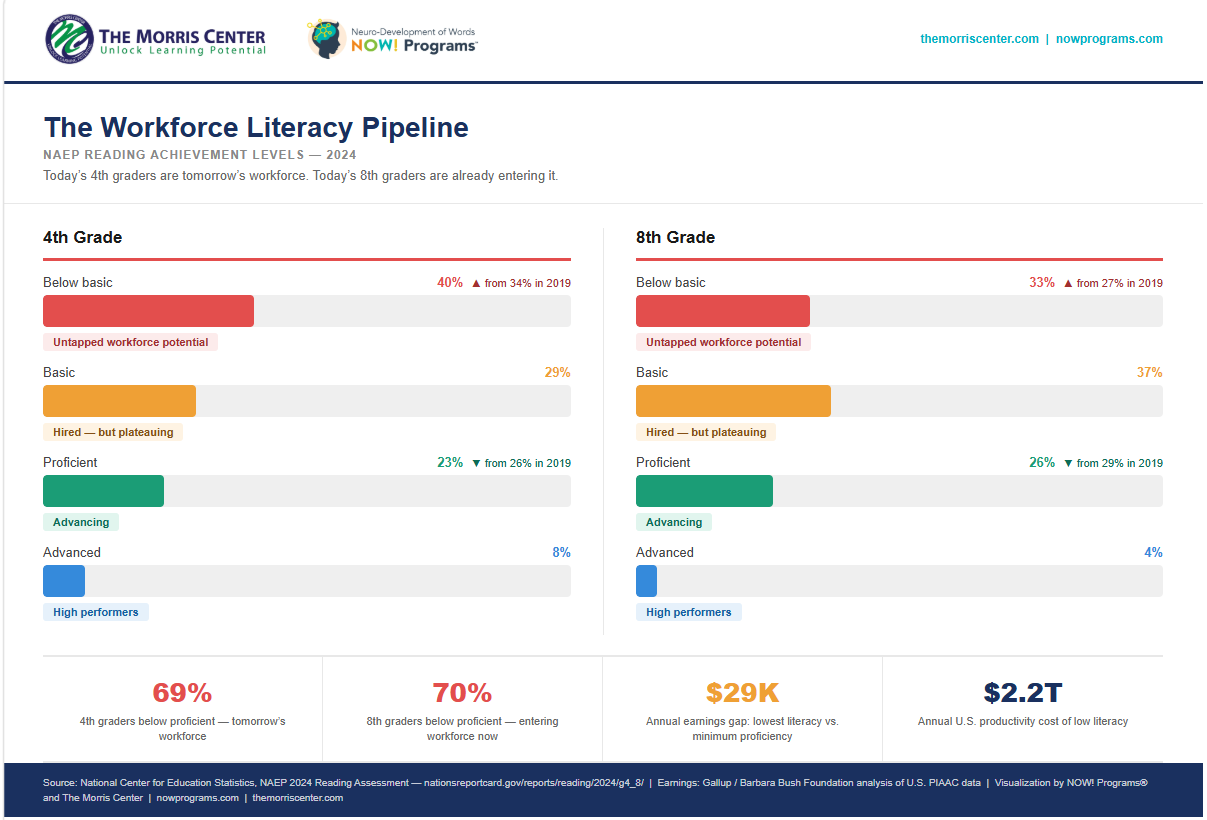
69% of 4th graders and 70% of 8th graders are below proficient in reading—signaling a growing workforce literacy gap.
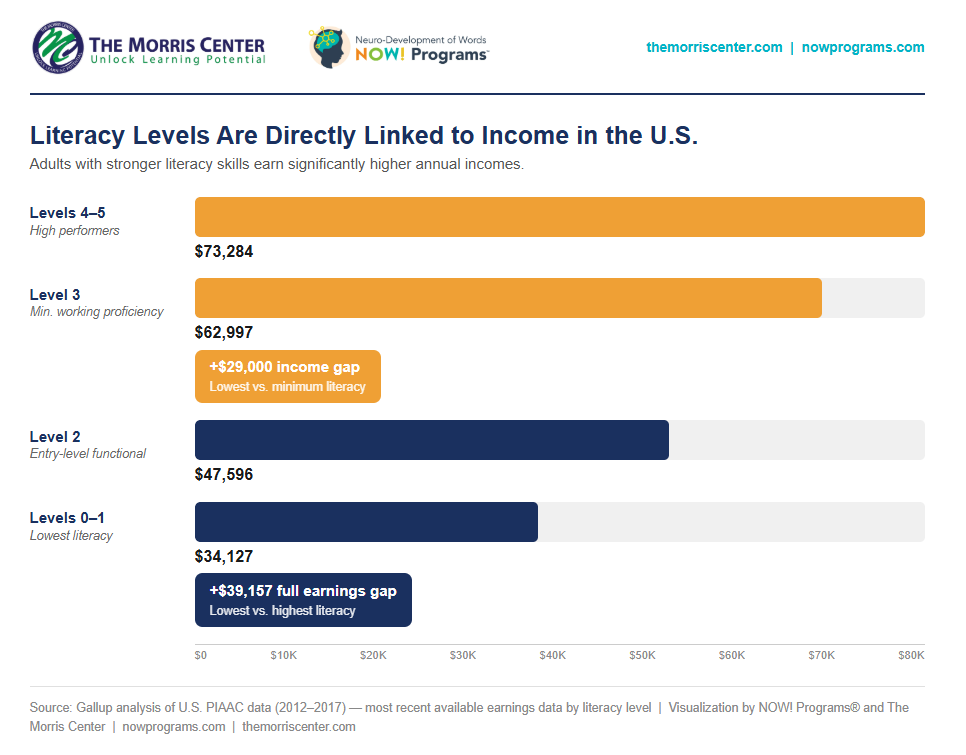
U.S. income rises with literacy: $34,127 at the lowest levels vs. $73,284 at the highest—a $39,157 gap, based on PIAAC data.
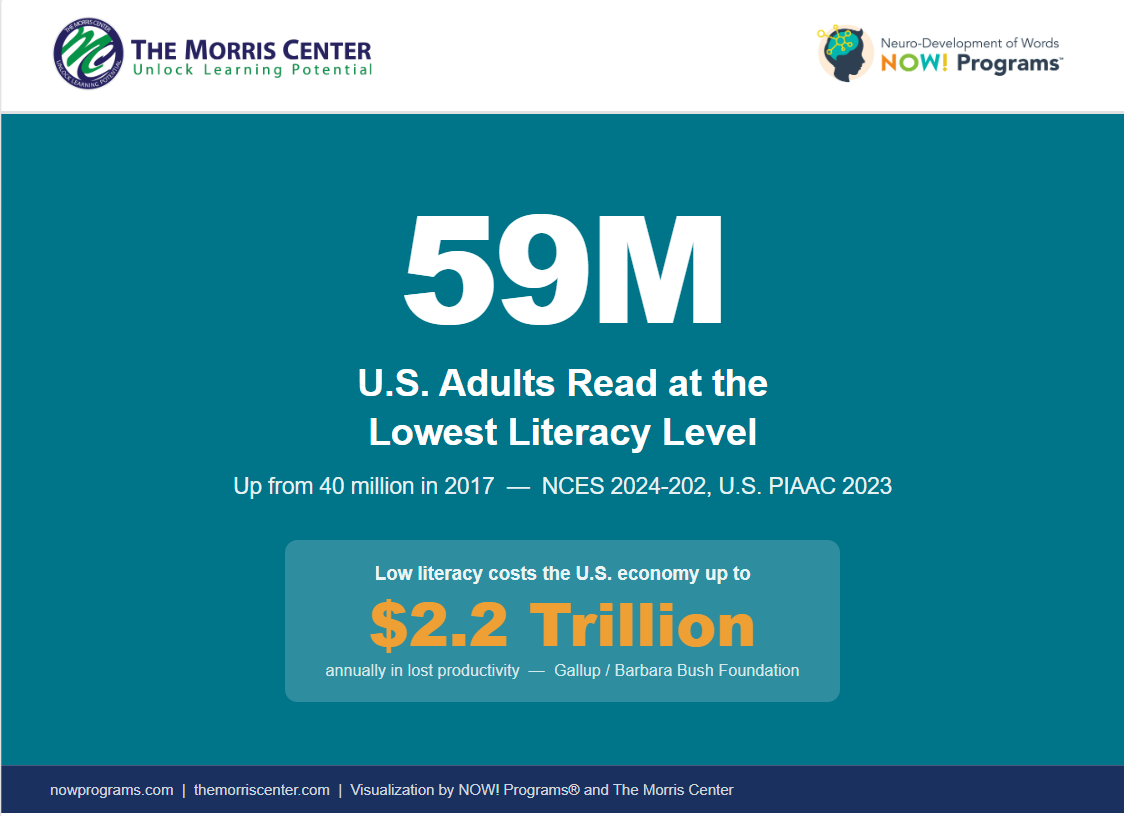
59 million U.S. adults read at the lowest literacy level, up from 40 million in 2017. Low literacy costs the U.S. economy up to $2.2 trillion annually in lost productivity.
The Neuro-Development of Words (NOW!) Programs™ logo, a neuroscience-based speech-to-print literacy program supporting reading, spelling, and language development for children with dyslexia and related learning differences.
As Anthropic data shows AI mirrors worker literacy, employer investment in evidence-based reading instruction is emerging as a workforce development priority.
Neuropsychology and literacy researcher Dr. Tim Conway, PhD, founder of NOW! Programs®, argues that building foundational reading skills is now a necessary employer investment in the AI era. Employers can request a pilot consultation at NOWprograms.com.
Key Takeaways
• Low literacy refers to reading skills below the level required for workplace and daily functioning
• According to NCES, 28% of U.S. adults now perform at the lowest literacy level — up from 19% in 2017 — representing approximately 59 million adults (NCES 2024-202, U.S. PIAAC 2023)
• Low literacy costs the U.S. economy up to $2.2 trillion annually, based on estimates from Gallup and the Barbara Bush Foundation
• Anthropic’s January 2026 Economic Index found: “How humans prompt is how Claude responds — the education levels of human prompts and AI responses are nearly perfectly correlated (r > 0.92 at both levels)” — AI mirrors the user’s literacy level, it does not improve it
• NAEP data spanning more than 50 years shows the majority of U.S. students have consistently scored below the Proficient level in reading — a threshold NCES describes as demonstrating competency over challenging subject matter
• Evidence-based literacy instruction can significantly improve reading skills
• 40% of students who completed intensive evidence-based literacy instruction no longer required special education services — per a peer-reviewed randomized controlled trial in the Journal of Learning Disabilities (Torgesen et al., 2001); subsequent Morris Center outcomes document comparable gains in adult learners
• Dr. Conway argues that by the time a workforce skills gap becomes visible to employers, the school window has already closed — making employers a critical new access point for evidence-based literacy instruction
View independently measured outcomes, research summaries, and implementation models: NOWprograms.com | TheMorrisCenter.com | LipLetterLand.com
The literacy challenge facing U.S. employers extends well beyond the least-educated workforce. According to the 2023 Survey of Adult Skills — conducted by the Organisation for Economic Co-operation and Development (OECD) across 31 countries and administered in the United States by the National Center for Education Statistics (NCES) — even adults with more than a high school education saw their lowest-literacy percentage double, from 6 to 13 percent, between 2017 and 2023. This is not a dropout problem. It reaches into every hiring tier.
• 4th grade 2024: 69% below proficient (▲ from 65% in 2019) — 40% below basic (untapped workforce potential, ▲ from 34%) and 29% at basic (hired but plateauing); only 23% proficient (▼ from 26%) and 8% advanced — NAEP 2024
• 8th grade 2024: 70% below proficient (▲ from 66% in 2019) — 33% below basic (untapped workforce potential, ▲ from 27%) and 37% at basic (hired but plateauing); only 26% proficient (▼ from 29%) and 4% advanced — NAEP 2024
The Basic tier — 29 percent of fourth graders and 37 percent of eighth graders — represents workers who get hired but plateau: functional enough for entry-level roles, but without the reading skills needed to advance, interpret complex AI output, or respond to rising skill demands.
As the below-basic group grows and the proficient group shrinks, employers face a narrowing pipeline of candidates ready to advance — and a widening pool who will need support to reach their potential.
Workarounds Have Limits. Reading Skills Open Doors.
The dominant workplace response to low literacy has been accommodation: extended time, text-to-speech software, and, increasingly, generative AI. Accommodations serve an important and legally protected role — but they were not designed to build foundational reading skills. Dr. Conway argues that by the time a workforce skills gap becomes visible to employers, the school window has already closed — making employers the most direct access point for evidence-based literacy instruction. Effective AI use requires the ability to read, interpret, and evaluate complex information — skills that AI tools cannot supply to users who do not already have them.
Anthropic’s January 2026 Economic Index found: “How humans prompt is how Claude responds — the education levels of human prompts and AI responses are nearly perfectly correlated (r > 0.92 at both levels).” The OECD frames the same challenge in workforce terms: “In a world of work where skill requirements are rising, particularly as a result of the digital transition and adoption of AI, adults with low literacy skills do not fare well. These foundation skills are crucial to navigate new opportunities at work.” (OECD, Adult Skills and Work, oecd.org/en/topics/adult-skills-and-work.html). The implication is direct: AI training cannot compensate for missing foundational reading skills — it amplifies whatever literacy the worker brings to it.
Dr. Conway’s research offers a different path entirely.
Drawing on fMRI research, his work shows that the brain pathways involved in reading are not fixed — they can be strengthened and reorganized through targeted instruction delivered at sufficient intensity. His research spans both developmental reading challenges and acquired reading loss — including peer-reviewed, VA-funded findings showing that reading skills can be rebuilt even after neurological damage from stroke or brain injury. The implication for workforce development is direct: if the methodology produces measurable gains on a neurologically damaged brain, the outcomes on an intact brain are demonstrably achievable. While many approaches are described as multisensory, outcomes vary widely; studies that tightly control instructional sequence, intensity, and fidelity have demonstrated significantly stronger and more consistent gains, including in randomized controlled trials.
One example is the NOW! Foundations for Speech, Language, Reading, and Spelling® model, implemented within The Morris Center’s Intensive Empowerment Program through structured, neurologically sequenced instruction delivered with defined intensity and fidelity. Unlike programs that rely solely on third-party research, the methodology which was subsequently branded NOW! Foundations for Speech, Language, Reading, and Spelling® was developed and peer-reviewed including a randomized controlled trial published in the Journal of Learning Disabilities showing 40 percent of students no longer requiring special education services following intensive instruction (Torgesen, Alexander, Wagner, Rashotte, Voeller, & Conway, 2001). Subsequent clinical outcomes documented by The Morris Center across more than 30 years show comparable gains in adult learners. The methodology traces to training under Patricia Conway Lindamood, who co-authored a series of literacy programs beginning in 1969, and collaborators including renowned researcher Dr. Joseph Torgesen and Professor Emeritus Dr. Kenneth Heilman.
“Improved reading skills open both access and advancement,” said Dr.
Tim Conway. “NICHD-funded research established this — and four
decades of documented outcomes have proven it. The question is whether employers invest — or keep absorbing the $2.2 trillion cost.”
Reading Instruction as an Employee Benefit: A New EAP Category
Dr. Conway is now positioning NOW! Programs® as an employer benefit, arguing the business case parallels student-loan repayment benefits a decade ago. The program is structured for employer implementation:
• Covers adult employees and their dependent children
• Online sessions begin at approximately $30 per hour
• Intensive programs typically completed within 2–8 months
Literacy Intervention Results: Independently Measured by Schools and Families
Independent assessments administered by schools — including NWEA MAP and STAR across districts in New York, Pennsylvania, Florida, and Missouri — document the following outcomes for students who completed NOW! Programs® instruction:
• 40 percent of students who completed intensive evidence-based literacy instruction no longer required special education services — as documented in a peer-reviewed randomized controlled trial published in the Journal of Learning Disabilities (Torgesen, Alexander, Wagner, Rashotte, Voeller, & Conway, 2001); subsequent Morris Center outcomes document comparable gains in adult learners
• Students entering instruction in the bottom 10th percentile advancing to the 50th– 80th percentile range on school-administered NWEA MAP and STAR assessments
• A 13-year-old homeschooled student who had been a non-reader progressing to 12th-grade reading accuracy in under 10 months — and independently completing the Harry Potter series six months after completing the program
• A student earning a silver medal at SkillsUSA nationals after overcoming significant reading barriers earlier in his education
The 21st Century Dyslexia Act and What It Means for Schools and Employers
The bipartisan 21st Century Dyslexia Act (S. 3010 / H.R. 5769), introduced in October 2025 by Sen. Bill Cassidy, Sen. John Hickenlooper, and Rep. Erin Houchin, has renewed federal debate over how schools identify and serve students with low literacy or dyslexia. According to the Learning Disabilities Association of America, 75–80 percent of students receiving special education services under a learning disability classification have their primary deficits in language and reading — yet only 8.2 percent of students receiving special education services return to general education, according to U.S. Department of Education data. This underscores the need for scalable, evidence-based literacy instruction that addresses the root cause rather than managing symptoms.
About NOW! Programs®
Founded in 2013 by Dr. Tim Conway, PhD, NOW! Programs® deliver neurologically sequenced, multisensory literacy instruction grounded in NICHD-funded research with outcomes documented across more than 30 years of clinical practice. Online sessions are available starting at approximately $30 per hour. Programs are typically completed within two to eight months.
NOW! Programs® is available as an Employee Assistance Program benefit for employers and is currently accepting employer pilot inquiries. Organizations can begin with a workforce literacy assessment to identify need and scope before committing to a full implementation. Request a pilot consultation at NOWprograms.com.
About The Morris Center
Founded in 1986 by developmental and behavioral pediatrician Dr. Ann Alexander, The Morris Center provides comprehensive assessment and intensive instruction for individuals with learning and developmental challenges. Led since 2008 by neuropsychology and literacy researcher Dr. Tim Conway, PhD, the organization’s Intensive Empowerment Program is grounded in NICHD-funded research with more than 30 years of documented clinical outcomes. The Morris Center operates clinics in Ponte Vedra Beach and Ocala, Florida, and in Trinidad & Tobago. Dr. Conway also co-founded The Einstein School, a tuition-free public charter school in Gainesville, Florida, serving students with dyslexia and learning differences. themorriscenter.com
###
Candice Johnson Polowitz
NOW! Programs®
+1 352-275-5778
email us here
Visit us on social media:
LinkedIn
Instagram
Facebook
YouTube
TikTok
X
Legal Disclaimer:
EIN Presswire provides this news content "as is" without warranty of any kind. We do not accept any responsibility or liability for the accuracy, content, images, videos, licenses, completeness, legality, or reliability of the information contained in this article. If you have any complaints or copyright issues related to this article, kindly contact the author above.
